For as long as there has been a watch, there were seven wanderers — the Sun, the Moon, and the five bright walkers that every civilization on earth found for itself. Seven planets, seven days, seven metals, seven gates: whole architectures of meaning stood on that number, and no one alive in 1781 had any reason to expect an eighth.
Then, on the night of March 13, a Hanoverian organist named William Herschel — a musician by trade, an astronomer by obsession, working with a seven-foot telescope whose mirror he had ground himself — swept his instrument through the border country of the Bull and the Twins and noted an object that showed a disc where a star should show a point. He logged it as a comet. It did not behave as one. Within months the mathematicians had its orbit: circular, remote, planetary. The sky had grown larger for the first time in recorded memory.
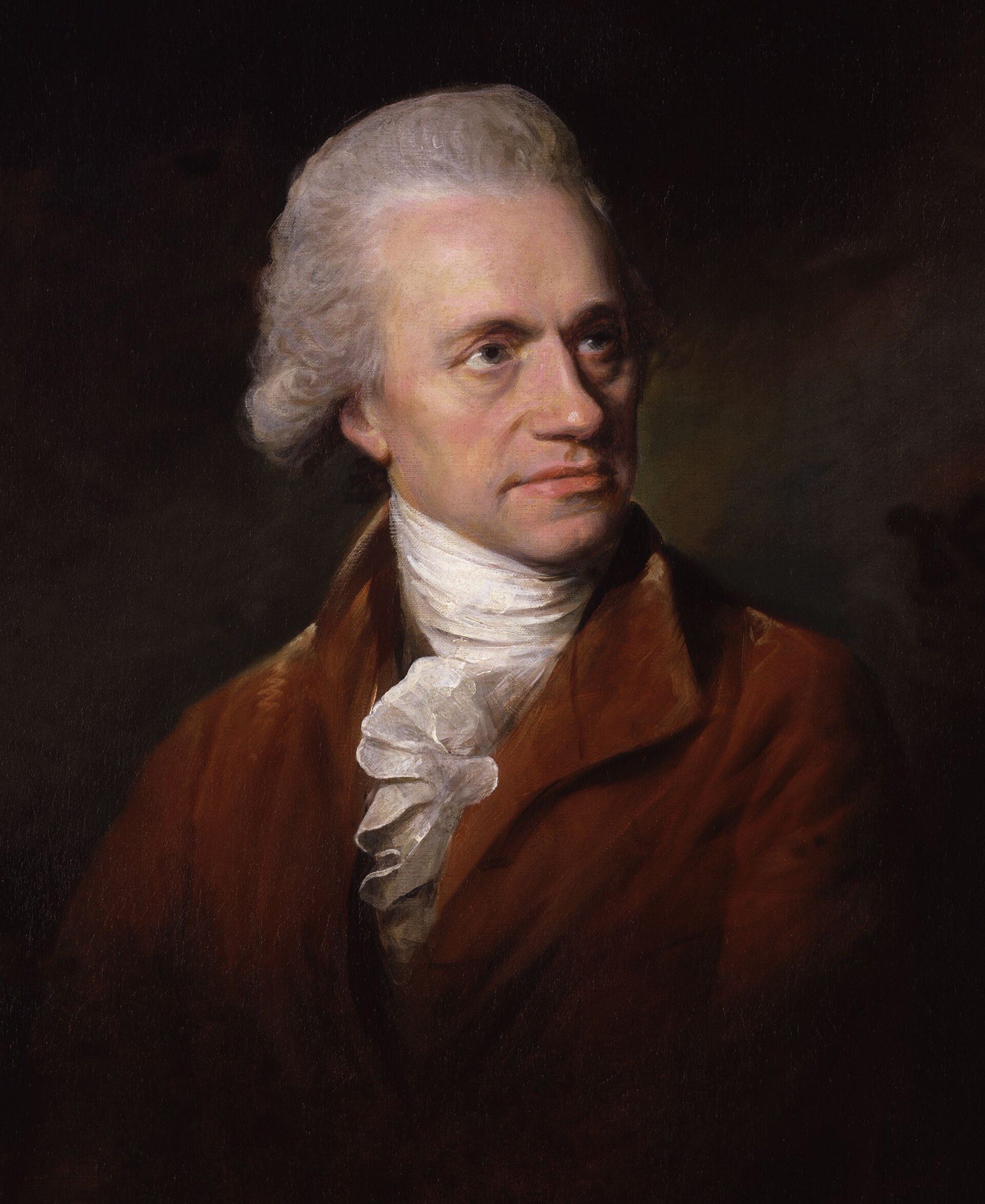
The planet no one noticed
Here is the detail the discovery story usually omits: Uranus had been seen many times before 1781. It sits at the edge of naked-eye visibility, and it appears in star catalogues compiled by careful men who mistook it for a fixed star — England's first Astronomer Royal, John Flamsteed, recorded it in 1690 and entered it as the star 34 Tauri. The sky had shown the planet to anyone who looked; it took Herschel's mirror, and Herschel's habit of examining everything rather than merely cataloguing it, to see that the point was a disc. Discovery was not a matter of new light. It was a matter of attention — which is, incidentally, the founding lesson of this whole house.
The naming took longer than the finding. Herschel, a Hanoverian in the service of an English king, proposed Georgium Sidus — George's Star — which the rest of Europe declined to write in its almanacs. The French preferred simply "Herschel." It was Johann Bode of Berlin who argued for mythological consistency: as Saturn fathered Jupiter, let Saturn's own father stand beyond him — Uranus, the oldest sky of all. Bode's logic won, though English almanacs held out for Georgium Sidus well into the next century. George III, for his part, granted Herschel a royal pension that let the organist give up music for the sky entirely.
Where it stood
The instruments below hold the night as the engine computes it: the new wanderer at twenty-four degrees of Gemini, precisely where Herschel's observing book places his "curious either nebulous star or perhaps a comet." The engine finds it there because the mathematics of the sky do not care whether anyone has noticed a thing yet — Uranus had been crossing the zodiac for all the millennia the watch was kept, too dim for the unaided eye, walking through every chart ever drawn, unnamed.
The old doctrine met the discovery honestly. A planet found by lens and mirror, in the sign of the Twins, in the decade of revolutions — the astrologers read the newcomer by watching what its arrivals coincided with, exactly as Babylon had built the meanings of the original seven. Uranus earned its reputation for overturning within a generation: found between the American revolution and the French, it has kept that signature since.
What the night teaches
Herschel himself was not finished finding invisible things. In 1800, splitting sunlight with a prism and laying thermometers along the spectrum, he noticed the heat continuing past the red edge where the light appeared to end — and so discovered infrared radiation, the first proof that the sky broadcasts on registers no human eye receives. The man doubled the solar system, then doubled the spectrum. Both discoveries teach the same doctrine: the heavens have always contained more than the unaided senses report, which the tradition had asserted, in its own vocabulary, all along.
The discovery is sometimes told as astrology's embarrassment — a planet the tradition never knew. The record reads it otherwise: the method that assigned meaning to Jupiter in Babylon assigned meaning to Uranus in the same way, by patient correlation of what stands above with what proceeds below. The instrument was new. The watch was the same one Nineveh kept. It has simply never stopped taking on staff.
| Sun | 23°44′ Pisces |
| Moon | 14°41′ Scorpio |
| Mercury | 11°43′ Aries |
| Venus | 2°54′ Pisces |
| Mars | 23°25′ Sagittarius |
| Jupiter | 27°25′ Scorpio ℞ |
| Saturn | 19°42′ Sagittarius |
| Uranus | 24°27′ Gemini |
| Neptune | 4°48′ Libra ℞ |
| Pluto | 6°13′ Aquarius |
Sun contends with Mars 0.3°
Sun contends with Uranus 0.7°
Mars faces Uranus 1.0°
Neptune flows openly toward Pluto 1.4°
Entries like this one arrive at each new moon. The ledger keeps your place.