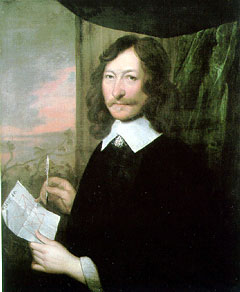
In 1651, William Lilly — the most famous astrologer in England, whose Christian Astrology had put the whole art into English for the first time — published a small book of prophetic images called Monarchy or No Monarchy. Among its woodcuts: twins falling headlong into a great fire, a city burning beside water. London's sign, in the old assignments, is Gemini. The twins are London.
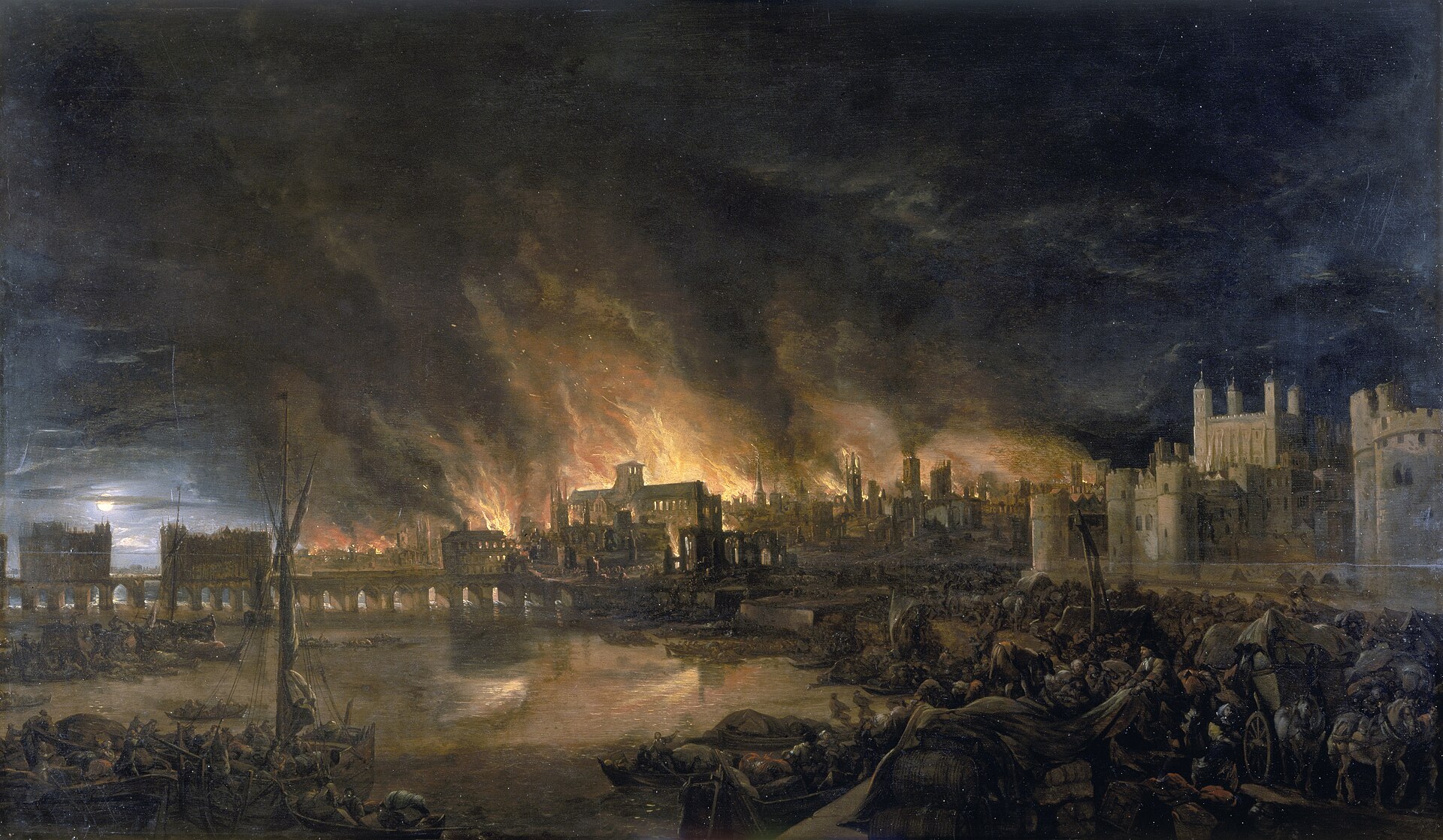
Fifteen years later, in the first hours of September 2, 1666, the house of the king's baker Thomas Farriner on Pudding Lane caught fire, and an east wind drove the flames through a city built of timber and pitch for four days. When the burning ended, the reckoning ran to more than thirteen thousand houses, above eighty parish churches, and St. Paul's Cathedral itself — most of London inside the old Roman walls, gone to ash.
The man the age consulted
To understand why Parliament cared what an astrologer had drawn, understand who Lilly was. His Christian Astrology of 1647 — the text stands in the observatory's reading room — was the first comprehensive manual of the art written in English rather than Latin, and it made the knowledge of the private scholars available to any literate tradesman: the same democratizing stroke this house continues. His yearly almanacs under the name Merlinus Anglicus sold in the tens of thousands, which made him, by circulation, one of the most-read men in England. Through the Civil War both sides had courted the astrologers, and Lilly's judgments ran for Parliament — his predictions of victory before Naseby were repeated in the army itself. When he published, England read.
So Monarchy or No Monarchy was not an obscure pamphlet. It was the most famous astrologer in the kingdom setting down, in nineteen enigmatic plates, what his art showed him of England's future — among the images, plague-shrouded corpses and a great city consumed by fire. London suffered the plague in 1665. The fire came the following September.
The summons
Parliament convened a committee to investigate the fire's causes, and in October 1666 it called Lilly to Westminster. The question beneath the questions was plain: a man who publishes a picture of London burning fifteen years early either reads the heavens or set the fire. Lilly's own account of the day survives in the autobiography he later wrote for his friend Elias Ashmole — he came attended by Ashmole himself, was treated with civility, and testified that his figures had shown him that the city would suffer by fire, not when or by what hand, and that having searched, he found no human design in it, judging it "the finger of God." The committee let him go; the fire was ruled accident, not arson. The woodcut remains in the printed record, dated beyond dispute — whatever one concludes, the picture came first.
The night, reconstructed
One honest note on the date, because the record keeps two calendars: England still counted by the old Julian reckoning in 1666, so Londoners lived September 2 — but the sky keeps its own count, and by the reformed calendar the fire's first night was September 12. The instruments below are set to that night as the heavens actually stood, whatever the parish registers wrote. Mars burned through Scorpio, his own ancient house, while Saturn ground retrograde through Capricorn — a sky the old doctrine would have read as iron and dry timber. The watchers of Nineveh kept their ledger the same way: what stood above, recorded without flinching, beside what happened below.
The city that rose from the ash kept one more secret in the same key. The Monument to the Great Fire — the 202-foot column Christopher Wren and Robert Hooke raised beside Pudding Lane — was built double: a memorial above, an instrument within. Its hollow shaft was designed to serve as a zenith telescope, and its underground laboratory was fitted for Hooke's experiments. London's monument to the fire an astrologer foresaw is, quite literally, an observatory. The seventeenth century kept its sky and its city in one architecture, which is a habit this house approves.
An astrologer's drawing, a committee of Parliament, and a city of ash — the seventeenth century did not doubt these belonged in one story. The record keeps them there.
| Sun | 19°24′ Virgo |
| Moon | 4°37′ Pisces |
| Mercury | 15°40′ Libra |
| Venus | 25°33′ Libra |
| Mars | 20°22′ Scorpio |
| Jupiter | 24°20′ Pisces ℞ |
| Saturn | 13°50′ Capricorn ℞ |
| Uranus | 21°14′ Aquarius ℞ |
| Neptune | 19°31′ Capricorn ℞ |
| Pluto | 28°38′ Gemini |
Sun flows openly toward Neptune 0.1°
Mars offers its hand to Neptune 0.8°
Mars contends with Uranus 0.9°
Sun offers its hand to Mars 1.0°
Entries like this one arrive at each new moon. The ledger keeps your place.