Every twenty years Jupiter overtakes Saturn, and the meeting falls about a third of the way around the zodiac from the last one. Join the meetings with lines and they draw a slowly turning triangle — a trigon — that keeps to signs of one element for roughly two centuries before passing to the next. The doctrine of these passings came down from Abu Ma'shar: when the triangle changes its element, an age changes with it. The watchers called that changing a great mutation.
In December of 1603, the triangle came home to fire. Jupiter and Saturn met at eight degrees of Sagittarius — the instruments below hold them a twentieth of a degree apart on the evening of the seventeenth — and the meeting opened a fiery era that the almanac-writers of Europe announced with the confidence of men reading a clock.
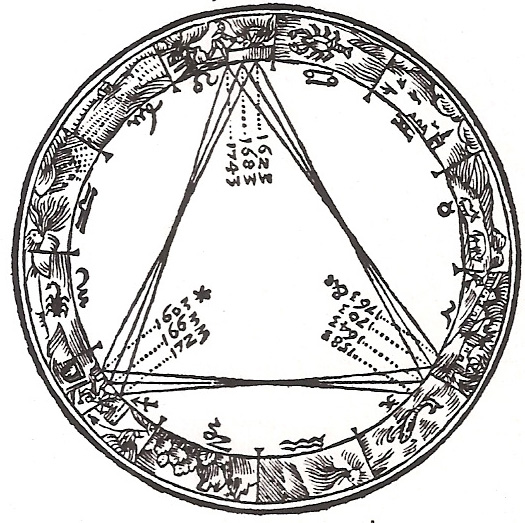
The clock behind the doctrine
The schema deserves to be seen whole, because it is one of the oldest long-range instruments the tradition possesses. Twenty years to a meeting; roughly ten meetings to a trigon's residence in one element; four elements to the full round — about eight hundred years from fire back to fire. Abu Ma'shar's On the Great Conjunctions, written in ninth-century Baghdad, made the returns of the fiery trigon the master-hands of the clock, and the schema passed through the Latin translators into every European court. The almanac-writers of Kepler's day could recite the sequence: a fiery era at the time of the patriarchs, another near the era of Moses, another at the birth of the era itself — the 7 BC meeting — another in the age of Charlemagne, and now, in 1603, the wheel come round again. Whether one credits the correspondence or merely the bookkeeping, the bookkeeping is real: the meetings fall where the doctrine says they fall, and the engine of this observatory computes every one of them.
The man at the window
The imperial mathematician at Prague watched the mutation with more than an almanac-writer's interest. Johannes Kepler traced the trigons backward, meeting by meeting, and found that a great mutation of the same fiery kind had stood in the sky at the turn of the eras — the triple conjunction of 7 BC, the meeting in Pisces that the Magi followed west. When a new star blazed out the following autumn beside the gathered planets, Kepler took it as the pattern confirming itself, and in De Stella Nova he set out the computation that still anchors the Bethlehem question four centuries later.
Then the sky underlined the argument. In October of 1604, with Mars and Jupiter and Saturn gathered close in the fiery signs, a new star flared out in the Serpent-Bearer — brighter than Jupiter, visible in daylight at its height, burning in the sky for the better part of a year. Kepler observed it from Prague night after night, and his De Stella Nova (1606) reads the coincidence directly: if a new star could attend the fiery mutation of his own age, what had attended the fiery mutation at the turn of the eras? In De vero anno (1614) he pressed the computation home, placing the triple conjunction in 7 BC and arguing the star of the Magi belonged to that season.
Mark what actually happened there: a working astronomer, the finest of his age, used the doctrine of the great conjunctions as an instrument of historical research — and the instrument worked. The 7 BC conjunction is real. The mathematics held from Prague back to Babylon.
What the mutation timed
The fiery trigon that opened in 1603 presided over the era the historians still treat as a hinge: the wars of religion burning out, the old order of thrones giving way, the new philosophy rising — Kepler's own laws among its first stones. Whether the sky governed the turning or merely kept its time, the seventeenth century did not much care to distinguish. The triangle turned; the world turned. The record holds both, side by side, and the arithmetic still closes.
| Sun | 25°27′ Sagittarius |
| Moon | 16°55′ Gemini |
| Mercury | 4°33′ Sagittarius |
| Venus | 26°19′ Sagittarius |
| Mars | 4°00′ Libra |
| Jupiter | 8°11′ Sagittarius |
| Saturn | 8°15′ Sagittarius |
| Uranus | 14°12′ Taurus ℞ |
| Neptune | 6°46′ Virgo ℞ |
| Pluto | 25°22′ Aries ℞ |
Jupiter stands with Saturn 0.1°
Sun flows openly toward Pluto 0.1°
Mercury offers its hand to Mars 0.5°
Sun stands with Venus 0.9°
Entries like this one arrive at each new moon. The ledger keeps your place.