Three times in a single year the two farthest wanderers known to the old watch drew together in the sign of the Fishes: in the spring, again toward autumn, and a last time as winter came on. A meeting of Jupiter and Saturn comes only once in twenty years; a triple meeting, with both planets pacing backward and forward past one another in the same sign, is the work of centuries. The year was what your calendar calls 7 BC, and the watchers keeping it belonged to the same unbroken discipline that had already fixed history's clock with an eclipse over Nineveh seven centuries before. The watchers did not stumble upon it. A tablet from Sippar — a star almanac drawn up for that very year — lists the comings and goings of the two planets in Pisces month by month, in advance. Babylon knew it was coming the way you know the date of the next eclipse.
Three meetings, one year
The mechanics are what make the year singular. Jupiter overtakes Saturn once in twenty years, and ordinarily passes it once and moves on. But when the meeting falls near the point where Earth's own motion makes the outer planets appear to halt and walk backward, the passing happens three times: Jupiter overtakes Saturn, retrogrades back across it, then turns and passes it a final time. In 7 BC the three passes fell in spring, in early autumn, and in the first days of winter — three conjunctions in a single year, all within the Fishes, a performance the sky stages only once in centuries. The instruments below hold the third and final pass; the watchers had already logged two.
And they had logged them in advance. The tablet from Sippar — the star almanac catalogued as BM 35429, drawn up for that very year — lists the movements of Jupiter and Saturn through Pisces month by month before they happened. Babylonian astronomy by that era predicted planetary positions arithmetically, from period-tables refined over centuries of the Diaries' observations. The Magi did not chase a surprise. They kept an appointment.
What the meeting meant
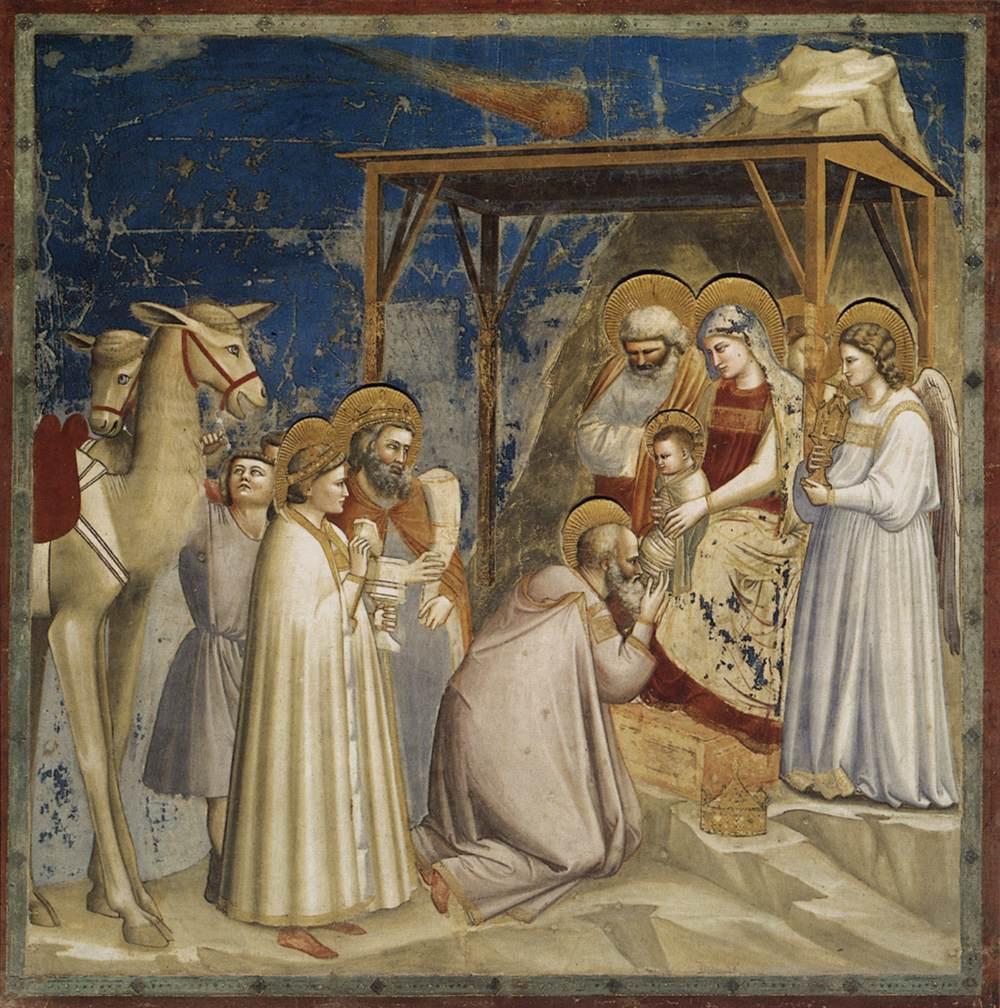
Read it as the watchers read it. Jupiter was the king-maker, the star of legitimate sovereignty; Saturn was the old lord of boundaries, of long time and of the West; and Pisces held the reputation, in the later doctrine, of governing the lands toward the sunset sea — Syria and the country behind it. Set the three together and the sentence forms almost of itself: a king is appointed, by the ancient order, in the West. Whether the men who rode out from the East that generation were following this meeting or another sign, the record cannot close. But when the historians ask what stood in the sky worth saddling camels for, this is the answer with tablets behind it.
The old arithmetic of Abu Ma'shar, centuries later, would build a whole doctrine of history on exactly these meetings — the great conjunctions beating time beneath the rise of kingdoms and creeds, the slow clock by which ages turn. He was systematizing what Babylon already practiced: when the two slowest wanderers meet, the watch takes notice, because the world tends to.
The question never closed, and the best minds kept returning to it. Sixteen centuries later, watching a great conjunction of his own in 1603, Johannes Kepler traced the cycle back and computed the 7 BC meetings afresh, arguing in De vero anno that the Magi's star belonged to this season. Later Jewish tradition — Abarbanel's commentary chief among its witnesses — held Pisces for the sign of Israel, which folded the reading tighter still. Every age has re-read this year with its own instruments; the year has never failed the examination.
The night, reconstructed
Below stand the positions for an evening in early December of 7 BC, the season of the third and final pass, computed by the engine from Babylon's meridian. The two planets sit within a fraction of a degree of one another, fifteen degrees into the Fishes, with the Sun far away in the Archer and the Moon riding high. The instruments confirm what the tablet promised. They usually do.
| Sun | 7°45′ Sagittarius |
| Moon | 9°31′ Aries |
| Mercury | 0°40′ Sagittarius |
| Venus | 4°10′ Scorpio |
| Mars | 20°07′ Capricorn |
| Jupiter | 15°10′ Pisces |
| Saturn | 15°21′ Pisces |
| Uranus | 2°00′ Pisces |
| Neptune | 5°56′ Scorpio |
| Pluto | 12°03′ Virgo |
Jupiter stands with Saturn 0.2°
Mercury contends with Uranus 1.3°
Sun flows openly toward Moon 1.8°
Venus stands with Neptune 1.8°
Entries like this one arrive at each new moon. The ledger keeps your place.