The Emerald Tablet is a text of thirteen lines attributed to Hermes Trismegistus — the shortest founding document any tradition has ever had. It carries the maxim the whole Western esoteric tradition is built on, that which is below is like that which is above, and the alchemists treated it as the charter of their art for a thousand years.
It can be read complete in about two minutes — the observatory's reading room holds it free, in the English of Isaac Newton's own hand.
Where it actually comes from
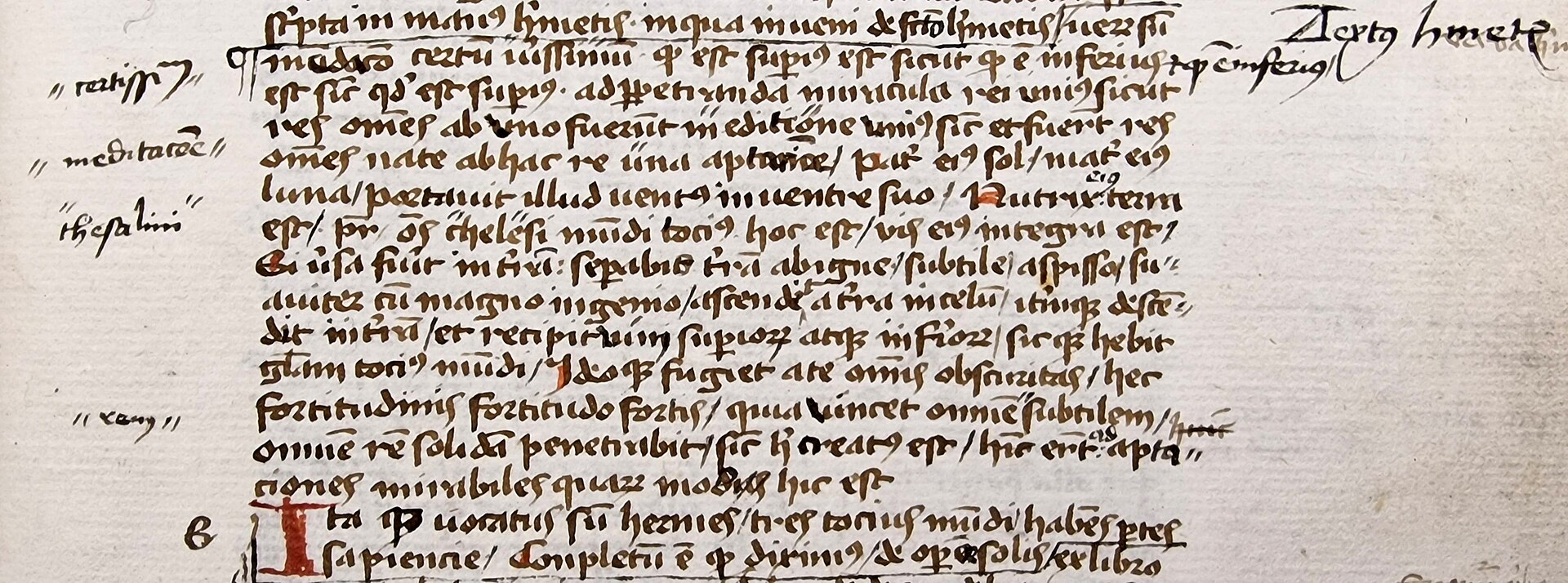
The romance says an emerald slab found clutched in the hands of Hermes in his tomb. The record says something almost better. The earliest text we possess is Arabic, embedded in the Kitāb sirr al-khalīqa — the Book of the Secret of Creation, attributed to Balīnās — compiled around the eighth century. From there it entered Latin in the twelfth, in the translation workshops where Arabic learning crossed into Europe, and by the Renaissance no alchemical library was without it. No Greek original has ever been found; no emerald either. What is certain is the text's authority: for the alchemists, these thirteen lines outranked whole shelves.
What the thirteen lines teach
Strip the aura and the tablet makes three claims. First, the correspondence: above and below are one fabric, so the study of either reveals the other — the sentence that licenses astrology, alchemy, and every doctrine of signatures at once. Second, a process: separate the subtle from the gross, "sweetly, with great industry" — ascend from earth to heaven and descend again, gathering the power of both. The alchemists read that as the formula of the Great Work itself, whether worked on metals or on the soul. Third, a signature: the author calls himself Hermes the Thrice-Great, holding the three parts of the philosophy of the whole world.
Newton — who copied and translated the tablet among his alchemical papers, the manuscript now catalogued as Keynes MS 28 at King's College, Cambridge — took it seriously enough to work through line by line. The greatest mathematician of his age filed it beside his optics. The world nearly never learned this: Newton's alchemical manuscripts stayed out of sight for two centuries until they were dispersed at auction in 1936, where the economist John Maynard Keynes bought a great share of them and read what the age of reason had preferred to forget. His verdict on their author has become the famous one — Newton was not the first of the age of reason, but the last of the magicians. The tablet in our reading room is the text that sentence was written about.
How a thousand years read it
The tablet's authority was built by its commentators, and the greatest of them treated it as a working document. The gloss that circulated most widely — written in the fourteenth century under the name Ortolanus, "the gardener" — reads the thirteen lines as laboratory instruction start to finish: the separations, the gentle heat, the ascents and descents of distillation, each sentence a stage of the work on the philosopher's stone. Whole generations of practical alchemists met the tablet through Ortolanus before they met it plain. Others read the same lines inward, as the regimen of the soul — purify, ascend, return carrying the power of both worlds — and the text supports both readings without strain, which is much of why it survived every fashion.
The famous parentage line shows how the compression works. The Sun is its father, the Moon its mother; the wind hath carried it in its belly; the earth is its nurse. To the laboratory tradition: gold and silver as the seed of the stone, the volatile spirit that carries it, the mineral body that matures it. To the inward tradition: spirit and soul begetting the work, borne by breath, grounded in the body. Four short clauses, two complete systems — thirteen lines carrying whole libraries was always the design.
Read it whole
Summaries of the tablet outnumber the tablet ten thousand to one, which is exactly backwards for a text of thirteen lines. Read the thing itself: the full Newton translation stands in the reading room, free, two minutes of your attention — and after it, the tradition that grew from it fills the Hermetic hall of the Library. As above, so below is worn smooth as a keyring phrase. The lines around it still cut.
Entries like this one arrive at each new moon. The ledger keeps your place.