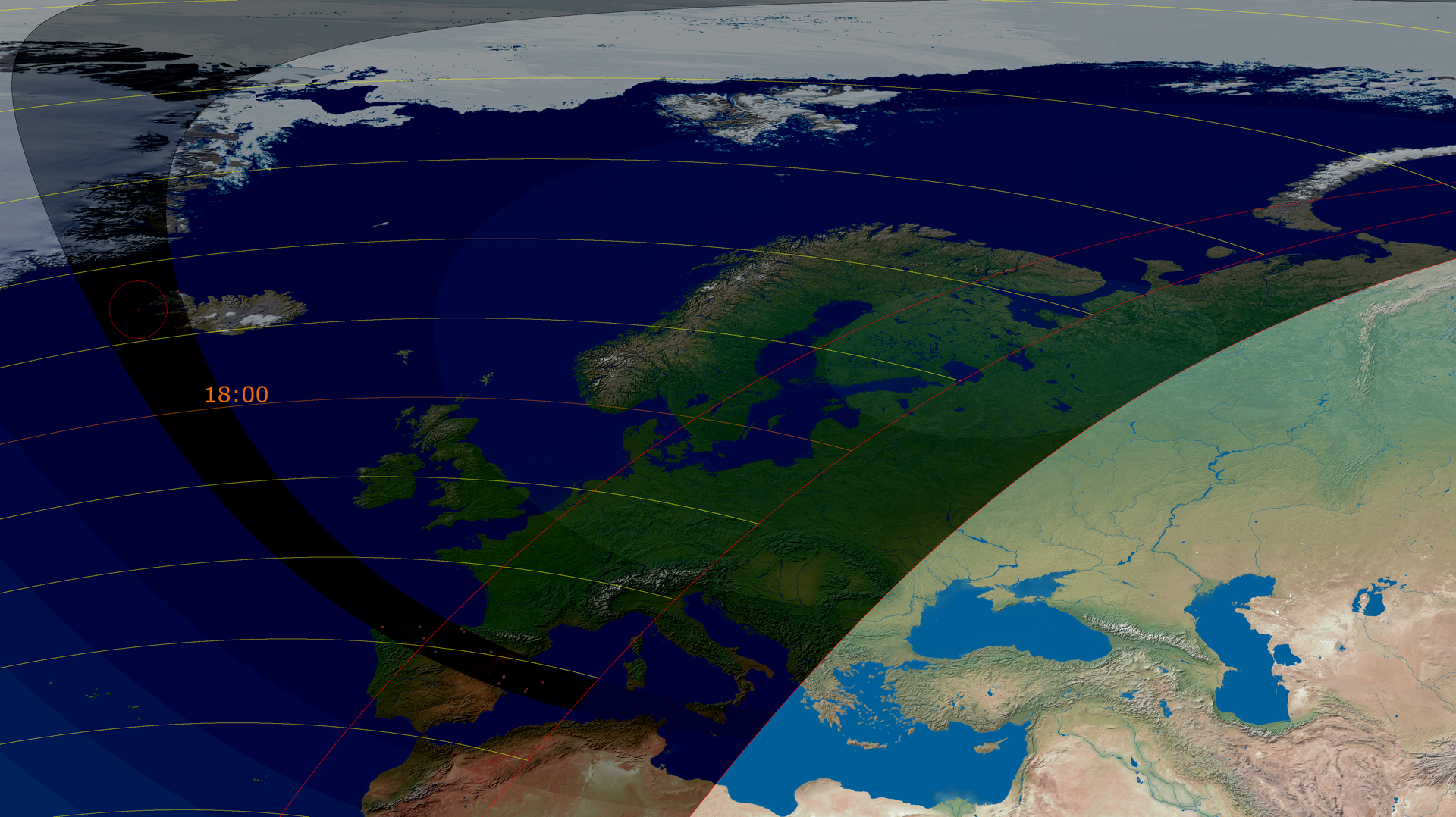
A month from the day this is entered in the record, the Moon's shadow will touch down in the high Arctic, cross Greenland and Iceland, and come ashore in the north of Spain in the last hour before sunset. Those who stand in the band — it is narrow; it always is — will watch the Sun go out over the Atlantic horizon with the corona hanging low and gold in the west. Mainland Europe has not stood under totality since the summer of 1999. A generation has grown up without seeing the day fail.
What an eclipse is, in the old doctrine
The watch has kept eclipses longer than it has kept anything else. To Babylon a darkened Sun was the gravest sentence heaven could hand down, and the doctrine sorted its meaning by the sign it struck: this one comes in Leo, the Lion, the Sun's own house — the royal sign, the sign of thrones. The old reading of an eclipse in Leo concerned kings directly: crowns in question, sovereignties tested. The kings of Nineveh took such mornings seriously enough to enthrone a substitute and wait out the danger in borrowed clothes. You are not asked to tremble as they trembled. You are asked to notice what they noticed — that the sky does nothing so rare without the world seeming, afterward, to have turned a page.
The mechanics, for the sober-minded: an eclipse is simply the New Moon perfected — Sun and Moon not merely in the same degree of the zodiac but on the same line of sight, the meeting made total. The instruments below show the two lights standing at the same degree of Leo at the appointed hour, which is all an eclipse is, and everything an eclipse is.
What totality is actually like
The mechanics of the hour, for those who will stand in it. The Moon's first bite from the Sun goes unnoticed without protection — the eye must be shielded by proper eclipse filters through every partial phase, and the Sun stays dangerous until the instant totality begins. Then, in the final minute, the light fails in a way no dusk resembles: shadows sharpen, the temperature drops, the horizon glows in every direction at once. When the last of the photosphere vanishes, the filters come off, and the corona stands revealed — the Sun's outer atmosphere, a crown of pale fire around a black disc, the single sight that every witness across every century describes with the same helplessness. Venus and the bright stars step out at midday. Totality on this track runs brief — under two minutes for most of the Spanish band — and then the diamond flare on the Moon's trailing edge announces the world's return, and the filters must go back on.
This eclipse belongs to Saros 126 — the great eighteen-year family of eclipses the Chaldeans first learned to count, each member returning a third of the world westward from the last. The watchers of Babylon could have predicted this one's ancestor; the arithmetic in this observatory's engine descends from theirs.
Where to stand
The band makes landfall on Spain's northern coast and runs southeast across the peninsula toward the Balearic Sea; the great cities of the north and east lie in or near it, and the rest of Europe sees a deep partial. The Sun will be low — this is an evening eclipse, the shadow racing the sunset — so choose a western horizon with nothing on it. Totality is brief. It is also, every witness agrees, the most unearthly thing the sky does.
Set it in its generation and the urgency clarifies. The last totality to touch mainland Europe crossed on August 11, 1999 — a whole generation of Europeans has never stood in the shadow at home. And the sky, having withheld for twenty-seven years, now gives twice: on August 2 of the following year, 2027, another total eclipse crosses the Strait of Gibraltar and grazes Andalusia with one of the longest totalities of the century. Two chances in twelve months, then the long drought resumes. The watch will be kept from the old world's shore again at last. Keep it from somewhere with a clear view west.
| Sun | 20°04′ Leo |
| Moon | 20°31′ Leo |
| Mercury | 5°11′ Leo |
| Venus | 5°56′ Libra |
| Mars | 0°56′ Cancer |
| Jupiter | 9°34′ Leo |
| Saturn | 14°30′ Aries ℞ |
| Uranus | 5°21′ Gemini |
| Neptune | 4°04′ Aries ℞ |
| Pluto | 3°54′ Aquarius ℞ |
Mercury offers its hand to Uranus 0.2°
Neptune offers its hand to Pluto 0.2°
Sun stands with Moon 0.4°
Venus flows openly toward Uranus 0.6°
Entries like this one arrive at each new moon. The ledger keeps your place.